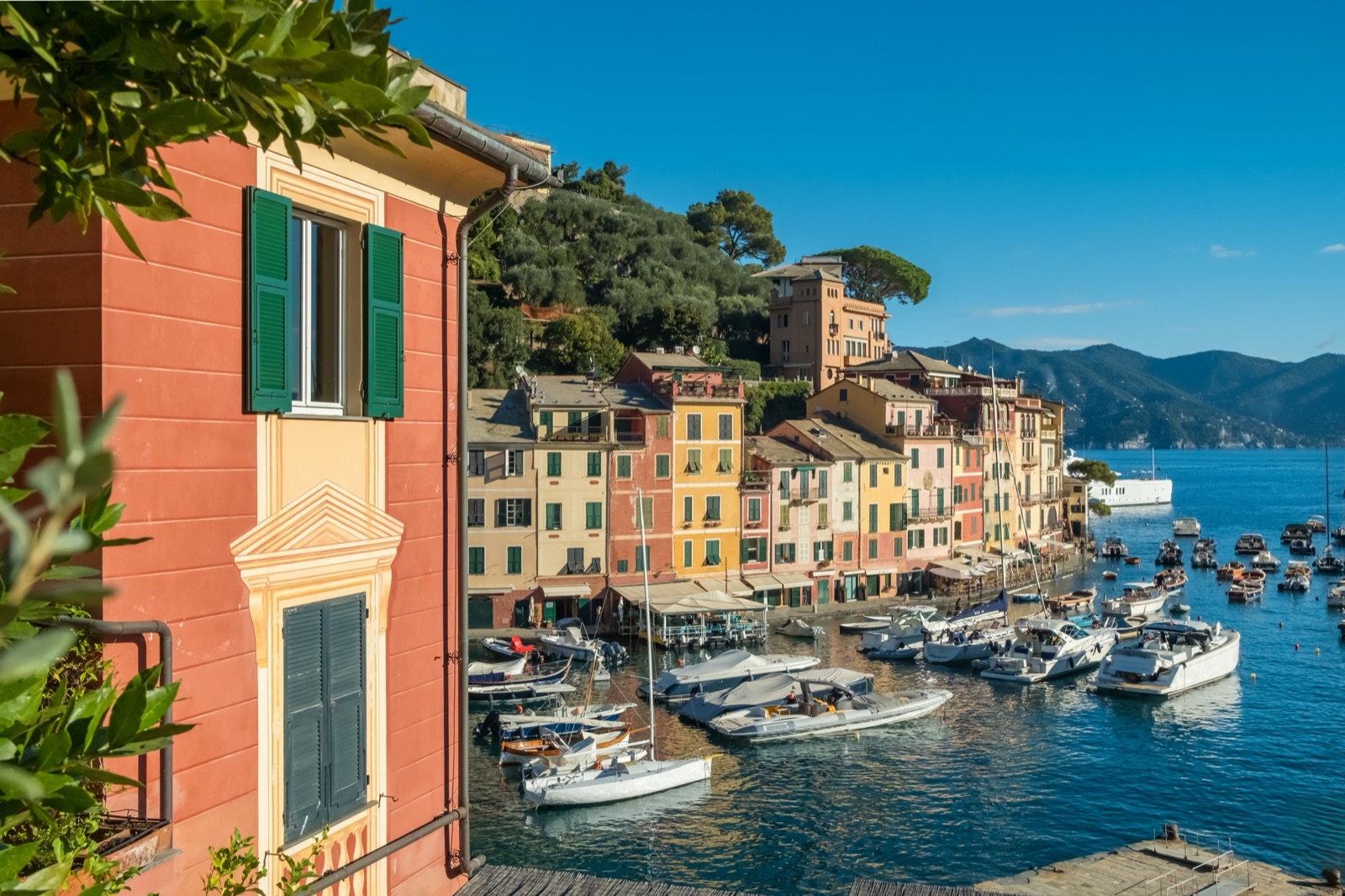
Portofino Village Guide: The Piazzetta, Castello Brown, the Lighthouse Walk and Where to Swim
Portofino is small enough to walk around in an hour, and yet many visitors leave feeling they have only skimmed it. The famous view — the curve of pastel houses around a harbour full of boats — is just the start. Above the village, paths climb through olive trees and gardens to a church, a castle and a lighthouse, each with a wider view than the last; below it, small bays offer clear water for a swim.
This guide covers what to see in the village and how to see it well: the piazzetta and harbour, the church of San Giorgio, Castello Brown and its terrace, the walk to the lighthouse at Punta del Capo, the best places to swim, and how to time your visit to avoid the worst of the crowds.
Portofino at a glance
- Portofino covers 2.53 km² and has 357 inhabitants (31 May 2026).
- Piazza Martiri dell’Olivetta, known as ‘La Piazzetta’, is the heart of the village.
- Since the late 19th century Portofino has drawn European aristocrats, and today it is a resort of the international jet set.
- The Portofino regional park was established by Law 1251 of 20 June 1935 and covers 1,055 ha of land in Camogli, Portofino and Santa Margherita Ligure, so the village is surrounded by protected land.
Getting there in brief
The nearest station is Santa Margherita Ligure–Portofino on the Genoa–La Spezia line; from there take bus line 782, a ferry or the coastal walk. The panoramic walk from Santa Margherita Ligure to Portofino is about 5 km. Drivers face a limited-traffic zone and a covered car park: the covered car park costs about €8 an hour, so if driving, leave the motorway at Rapallo, park before Portofino and take the bus or a ferry in; check the last return bus or boat. Our guide to getting to Portofino covers every option in detail, including boat trips from Genoa, Rapallo and Milan.
Arriving by ferry is the most memorable way in: the boat rounds the headland and the harbour opens up in front of you, exactly as in the photographs.
A short history
Portofino’s story is far older than its fame.
- The name comes from Portus Delphini, the ‘port of the dolphin’ mentioned by Pliny the Elder. Over time the two words merged into the name used today.
- The village is mentioned in a document of 986 by Adelaide of Italy, which assigned it to the Abbey of San Fruttuoso, the monastery in the next cove along the headland.
- The church was first built in Romanesque style in 1154, on the hill above the harbour.
- Castello Brown began as a medieval fortress built by the Genoese to guard the gulf.
- Since the late 19th century, the village has drawn aristocrats, artists and, later, the international jet set, and its fishing-village harbour became a symbol of Italian Riviera glamour.
The piazzetta and the harbour
The heart of the village
Everything in Portofino leads to the piazzetta, the small square that opens directly onto the harbour. Cafés spill onto the cobbles, the fishing boats and yachts rock at their moorings, and the painted façades rise behind. It is the place to sit, watch the boats come and go, and take in the scene.
What it costs
Sitting in the piazzetta is part of the experience, and it is priced accordingly: prices are high: a coffee for two at a piazzetta table costs €10 or more. If you would rather save, bring a picnic for the walk to the lighthouse.
Keep moving
The piazzetta and the lanes around it can be very crowded at midday in summer. Portofino has banned pedestrians from stopping in parts of the pedestrian zone, an anti-selfie measure to prevent crowds and queues. Look out for the signs, and step aside to a quieter spot for photographs.
The best views of the harbour
The classic view of the harbour is from above, on the path that climbs towards San Giorgio and Castello Brown. From the terrace of the church, and again from the castle, the whole curve of the harbour spreads out below.
The church of San Giorgio
On the headland above the harbour stands the church of San Giorgio, dedicated to the village’s patron saint.
- The church of San Giorgio keeps relics of St George, the village’s patron saint, brought back by Portofino sailors from the Crusades.
- The church was first built in Romanesque style in 1154 and rebuilt by the villagers in 1950 after wartime damage.
- St George’s Bonfire is held on 23 April, one of the most important days in the village calendar.
The churchyard terrace is one of the best viewpoints in Portofino, looking down on the harbour on one side and out to sea on the other.
Castello Brown
The history
Above the church, Castello Brown overlooks the whole bay. Castello Brown is named after Montague Yeats Brown, British consul in Genoa, who owned it from 1867 to 1905; it began as a medieval Genoese fortress guarding the gulf. The consul made it his home, and in 1870 the consul planted the two famous pines on the main terrace for his wedding day — trees that became symbols of the castle. The Municipality of Portofino bought the castle in 1961, and it now hosts exhibitions and events as well as visitors.
Tickets
- A ticket for the castle and its park costs €10.00.
- Children under 12 enter free; tickets are sold only at the entrance and cannot be bought online.
Opening hours
- Castello Brown opens 10:00–19:00 from 1 April to 31 May, 10:00–21:00 from 1 June to 30 August and 10:00–19:00 in September; last admission is 30 minutes before closing.
- In October it opens 10:00–18:00.
- From 1 November to 31 March it opens 10:00–16:00; in January only at weekends, 10:30–17:30.
Why visit
The terrace and gardens are the reason to come: from here you look straight down on the piazzetta and the harbour, and across the bay to the wooded headland. On summer evenings, with the castle open until 21:00, it is a lovely place to watch the light change over the village. Note that the castle is sometimes used for private events, so parts may be closed on some days.
The walk to the lighthouse
The route
The most rewarding short walk in Portofino leads from the piazzetta to the lighthouse at the tip of the headland. The walk from the piazzetta to the Punta del Capo lighthouse takes about 20 minutes, passing San Giorgio and Castello Brown, with many shaded stretches. It climbs gently through olive groves and gardens, past villas and along a path high above the sea.
At the lighthouse
From the lighthouse the view runs from Sestri Levante to Genoa, and a tiny bar has a terrace over the sea. It is a wonderful place for a drink at sunset, looking back along the whole Ligurian coast. Allow time to linger before walking back down to the harbour in the dusk.
Tips
- Go in the late afternoon, when the light is warmest and the day visitors are leaving.
- Wear comfortable shoes; there are steps and slopes.
- Combine it with Castello Brown, which lies on the way.
Where to swim
Portofino has no large beach of its own, but there are several places to swim within a short walk.
Baia Cannone
The nearest is Baia Cannone: Baia Cannone is about 500 m from Portofino and Paraggi about two kilometres. It is a rocky spot rather than a beach: Baia Cannone has no sand, cabins, showers or lifeguards, and its stones call for water shoes.
Niasca
Before Paraggi, coming from Portofino, is Niasca, a tiny bay without services reached by steps. It is small and peaceful, and a good place for an evening swim. Because it has no facilities, bring everything you need, and take care on the steps down, which can be slippery when wet.
Paraggi
Paraggi is the most famous bay near Portofino, with clear, turquoise water between wooded slopes. It is a pleasant walk along the coast from the village, and you can also park at Paraggi, about 1.5 km from Portofino, and walk to the piazzetta along the seafront in about 20 minutes.
On the water
The sea around Portofino is protected: the Portofino marine protected area was established by ministerial decree on 26 April 1999 and covers the municipalities of Camogli, Portofino and Santa Margherita Ligure. The clear water and rocky seabed make it excellent for kayaking and snorkelling.
Easy kayak tour to Portofino. With an instructor and marine guide, paddle from Paraggi to Portofino harbour and on towards the lighthouse, with optional snorkelling in the marine protected area. About 1.5 hours, and a wonderful way to see the village from the water.
Into the park
Behind the village, the wooded promontory is a protected park laced with footpaths. About 80 km of paths cross just over 1,000 hectares of the Portofino park, and the heart of the promontory can be reached only on foot. Most paths are old paved or earth tracks that once led to churches, hamlets, olive groves, woods and charcoal kilns, so walking them is a journey into the headland’s working past as much as its nature.
The park’s main gateways are San Rocco, Portofino Vetta, Nozarego and Portofino, and the main destinations Punta Chiappa, San Fruttuoso and Portofino. From the village, the most popular walk leads over the promontory to the abbey of San Fruttuoso, returning by boat. See our guide to San Fruttuoso and the Portofino park for routes and tips.
Eating and staying
Portofino is famously expensive, and it is worth knowing what to expect.
- In season, a hotel room in Portofino starts at around €700 a night, and a fish dinner costs at least €100 a person.
- A coffee for two at a piazzetta table costs €10 or more.
Many visitors stay in Santa Margherita Ligure or Rapallo and come to Portofino for the day or the evening. If you do eat in the village, a table on the harbour at sunset is the classic Portofino experience; for a lighter budget, bring a picnic for the lighthouse walk or the park.
Photography
- The harbour from above. The terrace of San Giorgio and the gardens of Castello Brown give the classic view of the pastel houses curving around the boats.
- Early morning. Before the crowds, the harbour is calm and the reflections at their best.
- The lighthouse at sunset. Looking back along the coast towards Genoa as the light fades.
- From the water. A kayak or boat shows the village as sailors have always seen it, framed by the wooded headland.
Tours that include Portofino
Half day from Genoa. An afternoon from Genoa’s Porto Antico along the coast to Portofino, with free time in Portofino. About 4.5 hours.
Boat from Genoa with free time in Portofino. Two hours in Portofino for the piazzetta and Castello Brown. About 5 hours.
Coastal cruise from Rapallo with a Portofino stop. A boat with a shaded sundeck from Rapallo, stopping in Portofino. About 4 hours.
The tours page lists them all with live prices.
Timing your visit
- Early morning is the quietest time: the harbour is calm, the light soft and the cafés just opening.
- Midday in summer is the busiest, when the boats and buses arrive. Spend it on the lighthouse walk or at Castello Brown.
- Late afternoon and evening bring the best light and fewer people. In July and August, evening boats run from Rapallo and Santa Margherita for dinner in the village.
- Out of season, Portofino is calm and mild, and the walks are at their most pleasant, though Castello Brown closes earlier.
Two ways to spend the day
A half day
- Arrive by ferry and have a coffee in the piazzetta.
- Walk up to San Giorgio and Castello Brown.
- Continue to the lighthouse for the view.
- Return to the harbour for a last look before the boat back.
A full day
- Morning: the lighthouse walk, San Giorgio and Castello Brown while it is cooler.
- Lunch: a picnic, or lunch in the village.
- Afternoon: a swim at Baia Cannone or Paraggi, or a kayak tour from Paraggi.
- Evening: back to the piazzetta as the day visitors leave, and a drink at the lighthouse bar at sunset.
Practical tips
- Bring cash and cards; the castle’s tickets are sold only at the entrance.
- Wear shoes with grip for the paths and the rocks at Baia Cannone.
- Carry water in summer; the walks are short but can be hot.
- Keep moving in the busiest lanes, and look for the no-stopping signs.
- Check your return boat or bus before you settle in for the afternoon.
With children
Children enjoy the boats, the castle and the walk to the lighthouse, and children under 12 enter Castello Brown free. The paths have steps and drops beside them in places, so keep small children close. For swimming, Paraggi is gentler than the rocks at Baia Cannone.
Accessibility
The harbour front and piazzetta are level and easy to get around, and the ferries and buses arrive right there. The climbs to San Giorgio, Castello Brown and the lighthouse involve slopes and steps and are not suitable for wheelchairs. Baia Cannone and Niasca are reached over rocks and steps; Paraggi is the easiest bay to reach.
Frequently asked questions
What is there to see in Portofino?
The piazzetta and harbour, the church of San Giorgio, Castello Brown and its terrace, the lighthouse at Punta del Capo, and the swimming bays of Baia Cannone, Niasca and Paraggi.
How much is Castello Brown?
€10.00 for the castle and its park; children under 12 enter free. Tickets are sold only at the entrance.
How long is the walk to the Portofino lighthouse?
About 20 minutes from the piazzetta, passing San Giorgio and Castello Brown.
Is there a beach in Portofino?
Not a sandy one in the village. Baia Cannone, about 500 m away, is rocky; Paraggi, about two kilometres away, is the best-known bay nearby.
Why is it called Portofino?
From Portus Delphini, the ‘port of the dolphin’ mentioned by Pliny the Elder.